When your marketing data
doesn't match reality
I investigate why.
Helping service businesses make confident marketing decisions.
Traffic vs Buying Intent
Getting traffic does not automatically mean you are attracting people who are ready to call, book, or buy. A page can bring in visitors, impressions, and even rankings while still failing to produce jobs.
Not sure if your traffic has real buying intent?
Most businesses see traffic in Google Search Console but can't tell whether those visitors are actually capable of becoming booked jobs.
The Pipeline Profit Inspection reviews the path between visibility and booked work to find where inquiries are breaking down.
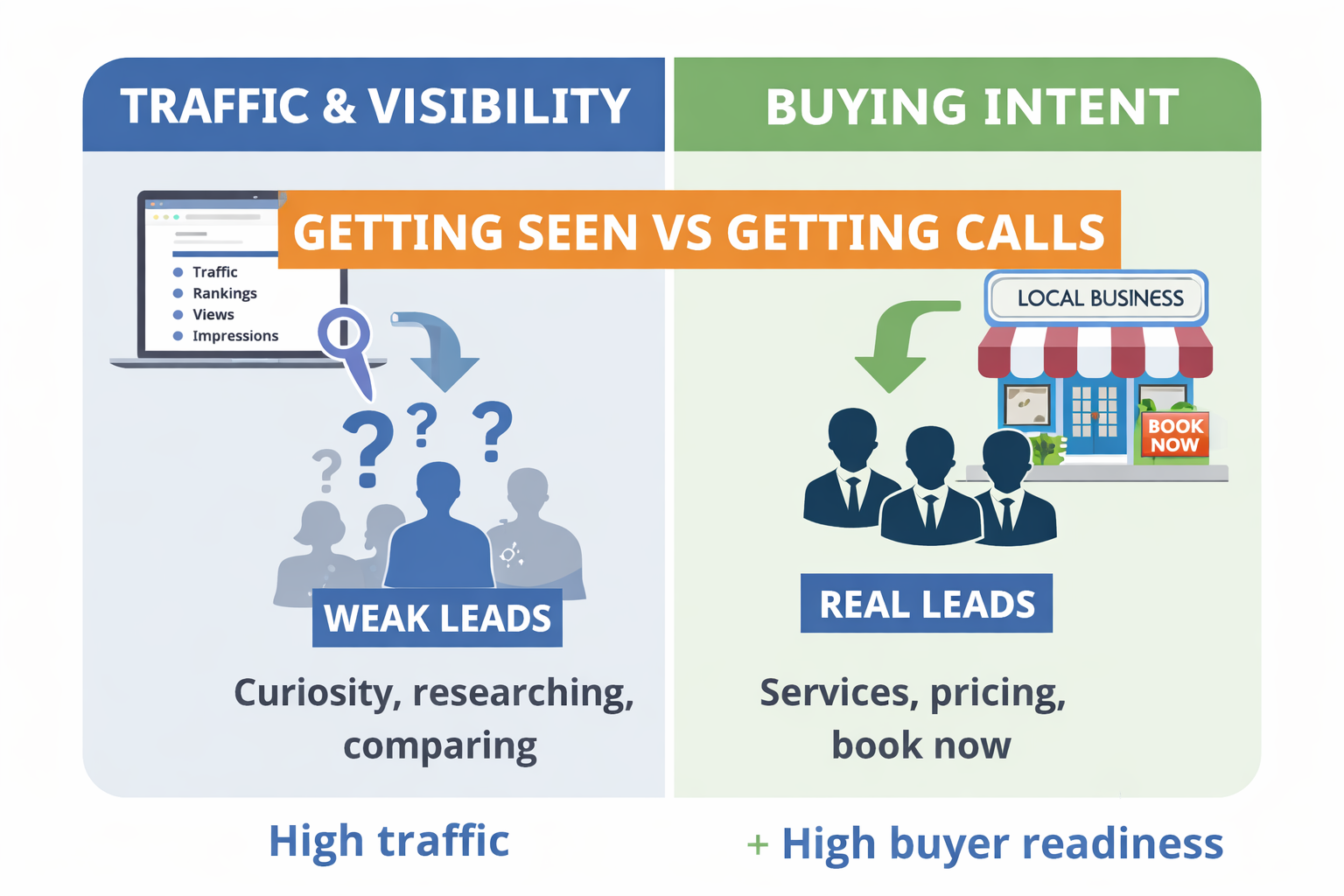
Why traffic can look healthy while revenue stays flat
A lot of business owners get trapped by surface-level numbers. They see traffic rising and assume the site is working. But traffic is only useful when it comes from people with the right problem, in the right area, at the right stage of decision-making.
A page can pull in visitors for broad searches, research searches, or low-intent searches that never lead to contact. That means the traffic looks good in a report, but it does not help the business.
- Someone searching for general information is not the same as someone ready to hire.
- Someone outside your service area is not a lead.
- Someone comparing ideas is not the same as someone needing service now.
- Someone looking for definitions, tips, or examples may never become a customer.
What buying intent actually means
Buying intent is the level of commercial readiness behind a search. It tells you whether the person is browsing, researching, comparing, or actively looking for a provider. The closer the search is to an immediate business need, the more likely it is to turn into a call or form submission.
- Low intent: informational searches, broad curiosity, early research
- Mid intent: comparison searches, problem-aware searches, local option review
- High intent: service + city, near me, pricing, availability, appointment, emergency, book now
This matters because many websites are accidentally built around low-intent traffic. They rank, but they rank for searches that do not move people toward action.
How this breaks down on local service websites
For local businesses, the gap between traffic and buying intent usually shows up in a few predictable ways.
- The page ranks for broad educational phrases instead of service phrases.
- The visitor lands on a page that answers a question but does not guide them toward contact.
- The content attracts people outside the service area.
- The searcher is looking for ideas, not a provider.
- The page earns impressions but does not match a real buying moment.
That is why a site can look active in Search Console and still produce weak call volume. The machine is running, but it is pulling the wrong people into the pipe.
What this means for Google Business Profile traffic
The same issue shows up in Google Business Profile performance. A profile can generate views without generating action. Visibility alone is not proof of demand quality. If people see the listing but do not click, call, or request directions, that usually means the listing is showing up in weaker search situations or the offer is not matching what the searcher wants.
That is covered more directly on the related page GBP views vs actions explained. Views are exposure. Actions are intent. The distance between those two numbers tells you a lot.
Signs you are attracting the wrong kind of traffic
- You are getting impressions but very few clicks.
- You are getting clicks but almost no calls or forms.
- Your top pages are educational but not commercial.
- Your map listing gets seen often but phone activity is weak.
- Your rankings look decent, but booked jobs stay flat.
That pattern usually means one thing: the search demand you are capturing is too soft, too broad, or too far away from a purchase decision. Fancy vanity metrics are doing their little tap dance while the phone stays quiet.
Traffic quality matters more than traffic volume
One high-intent visit is often worth more than fifty weak visits. A smaller number of the right searches can outperform a larger number of random searches every time. That is why service pages, local relevance, clear offers, and strong conversion paths matter so much.
It is also why chasing rankings without looking at buyer intent creates false confidence. You can win search visibility and still lose the revenue outcome.
How to diagnose the problem
To figure out whether your traffic has buying intent behind it, look at the whole path:
- What queries are bringing people in?
- Are those queries tied to services you actually sell?
- Are those visitors landing on pages built to convert?
- Are they from the right city or service area?
- Are they taking action after they arrive?
This is where many businesses realize they do not have a traffic problem at all. They have an intent mismatch.
How this page connects to the rest of content below
This page sits in the middle of the “why am I getting visibility but not calls” problem. The related pages break the issue down from different angles:
- Why your business ranks but isn’t getting calls explains the full mismatch between visibility and response.
- Ranking for keywords that don’t convert focuses on search phrases that bring traffic without producing business.
- GBP views vs actions explained shows why profile visibility is not the same as customer action.
- Showing up in Google Maps but no calls explains why map pack exposure can still fail to generate leads.
If your business is showing up in Google but calls are inconsistent, the problem is usually not traffic alone. Somewhere between visibility and contact, the pipeline is breaking down.
That breakdown can happen in the search queries bringing people in, the Google Business listing they see first, the page they land on, or the path that leads them to call or book. Most businesses cannot see where that break is happening without stepping back and looking at the entire flow.
The Pipeline Profit Inspection looks at the full path between visibility and booked jobs. It identifies where leads are leaking, where intent is mismatched, and what is preventing people from taking action after they find you.
What to do next
- Check which pages are bringing in traffic now.
- Review whether those pages target commercial searches or informational ones.
- Compare rankings against calls, form submissions, and real lead activity.
- Look at Google Business Profile visibility versus actual actions.
- Tighten your site around searches that signal real buying intent.
Related links
- Why Your Business Ranks but Isn’t Getting Calls
- Ranking for Keywords That Don’t Convert
- GBP Views vs Actions Explained
- Showing Up in Google Maps but No Calls
- Home
- Ranks but No Calls
- Traffic Vs Buying Intent