When your marketing data
doesn't match reality
I investigate why.
Helping service businesses make confident marketing decisions.
Homepage vs Service Page Hierarchy
A lot of local business websites try to make the homepage do everything. That usually creates a weak structure.
The homepage should not carry the full weight of every service, every city, and every sales message. Its job is different from the job of a service page.
When the hierarchy is clear, the site is easier for Google to understand and easier for visitors to use. That helps visibility turn into calls.
If your pages are getting traffic but not producing enough response, this is often part of the broader issue behind Why Most Service Pages Don’t Convert.
Start with the Pipeline Profit Inspection if your site is visible but the structure is not producing enough booked jobs.
The homepage and service pages do different jobs
The homepage is the front door. It introduces the business, confirms the main category, and routes people deeper into the site.
A service page does a different job. It focuses on one service and helps the visitor decide whether that specific service fits their need.
When those roles get blurred, the site becomes harder to understand. Google gets weaker signals. Visitors get weaker clarity.
For the full system behind this structure, see How to Structure Service Pages That Turn Traffic Into Booked Jobs.
What the homepage should do
A strong homepage usually needs to:
- identify what the business does
- confirm the main location or service area
- build broad trust
- link clearly to primary service pages
- make the next step easy
The homepage should not try to explain every service in depth. It should route people to the right place.
If the homepage tries to carry every decision by itself, the site often ends up broad, cluttered, and harder to convert.
What a service page should do
A service page should go deeper on one specific service. It should help the visitor answer a simple question: am I in the right place for this exact need?
That means the page should clearly explain:
- what the service is
- who it is for
- what problem it solves
- why this business is a credible choice
- what to do next
For a more detailed breakdown of those parts, see Anatomy of a High-Converting Service Page.
Why weak hierarchy hurts performance
A weak site hierarchy creates problems in two places: search engines and visitors.
If the homepage tries to rank for everything, service pages often stay thin or underdeveloped. That weakens topic clarity across the site.
It also creates a bad user path. Visitors land on broad pages instead of the page that best matches what they need. That is one reason businesses can end up getting traffic but no calls.
A simple service page hierarchy for most local businesses
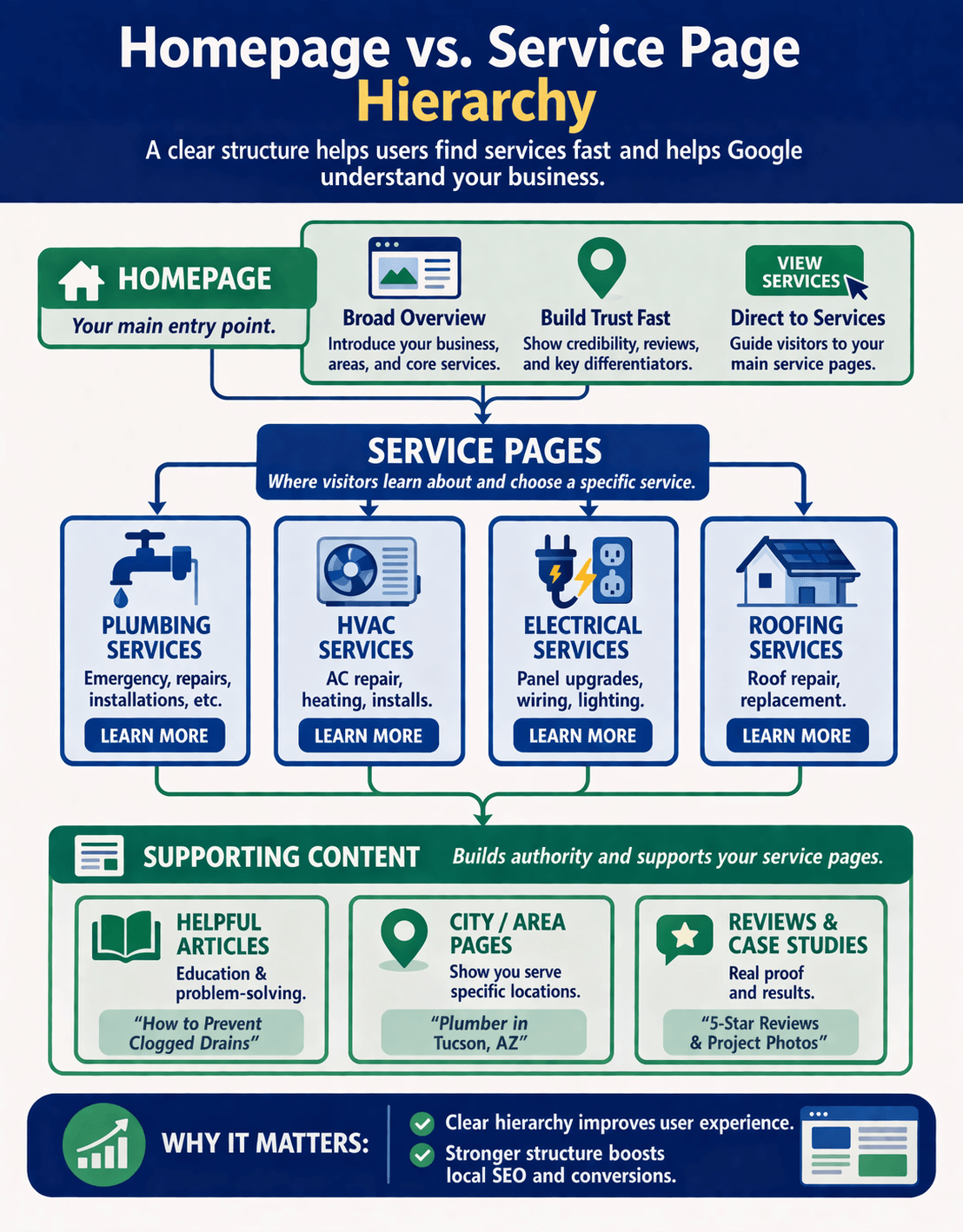
Most local service websites work better with a structure like this:
- Homepage — broad business overview and routing page
- Core service pages — main services the business wants to sell
- Supporting service pages — narrower or specialty services
- City or location pages — used when location targeting actually makes sense
- Support content — educational pages that reinforce authority and link back into service pages
This structure helps Google understand what the site is about and helps visitors move from broad understanding to specific action.
How the homepage should link down
The homepage should push authority into the most important service pages. That usually means linking clearly to the primary services the business wants to be known for.
Those service pages should then link to related supporting pages and, when useful, to closely connected city pages.
This is where internal linking matters. For more on that, see How Internal Linking Builds Local Authority.
When hierarchy problems show up
A messy structure often looks like this:
- the homepage tries to rank for every service and city
- service pages are thin or repetitive
- important services are buried in navigation
- city pages exist without enough purpose or support
- visitors land on the wrong page for the search they made
That kind of structure weakens both conversion and local authority.
Homepage authority is not enough by itself
Some businesses rely too heavily on the homepage because it feels like the strongest page on the site. But a homepage usually cannot do the full job of a well-built service page.
The homepage can introduce. The service page closes the gap between search and action.
If that page-level match is weak, the site may rank and still underperform. That is part of the same pattern behind Common Visibility-to-Call Breakdowns.
Where city pages fit into the hierarchy
City pages should not sit randomly in the structure. They should exist when there is a real location strategy behind them.
In many cases, city pages work best when they support a clear service structure rather than replacing it.
For more on that, see When to Create City Pages.
What good hierarchy does for conversions
A clear hierarchy helps the visitor move naturally through the site. They start broad, get specific, and then act.
That path usually looks like this:
- homepage or search result
- relevant service page
- trust and fit confirmation
- clear call to action
When the structure supports that path, the site feels easier to use. That lowers friction and increases the chance of a call or form submission.
What to do next
If your site structure feels broad, clutterd, or weak, start by clarifying the roles of each page type.
- tighten the homepage so it routes instead of trying to do everything
- strengthen core service pages so they carry real decision weight
- use supporting pages and city pages only where they add clarity
- improve internal links between related pages
If your site is visible but still not producing enough booked jobs, the Pipeline Profit Inspection looks at where the structure, handoff, or page path is breaking down.
- Home
- Service Page Structure
- Homepage vs Service Hierarchy