When your marketing data
doesn't match reality
I investigate why.
Helping service businesses make confident marketing decisions.
When to Create City Pages
City pages can help local visibility, but only when they support a real service structure. A lot of businesses create location pages too early, too broadly, or in bulk. That usually gives them more pages without giving them better results.
A city page should exist for a reason. It should help Google understand where the business is relevant and help the visitor confirm that the business serves their area.
If the structure is weak, city pages often become one more version of the same larger problem behind Why Most Service Pages Don’t Convert.
Start with the Pipeline Profit Inspection if your site is visible but your location pages are not producing enough calls.
What a city page is supposed to do
A city page should help answer a specific question: does this business offer this service in this area?
That means a city page should support both:
- local search relevance
- visitor decision clarity
If it does neither, it is usually unnecessary.
For the full structure model behind this, see How to Structure Service Pages That Turn Traffic Into Booked Jobs.
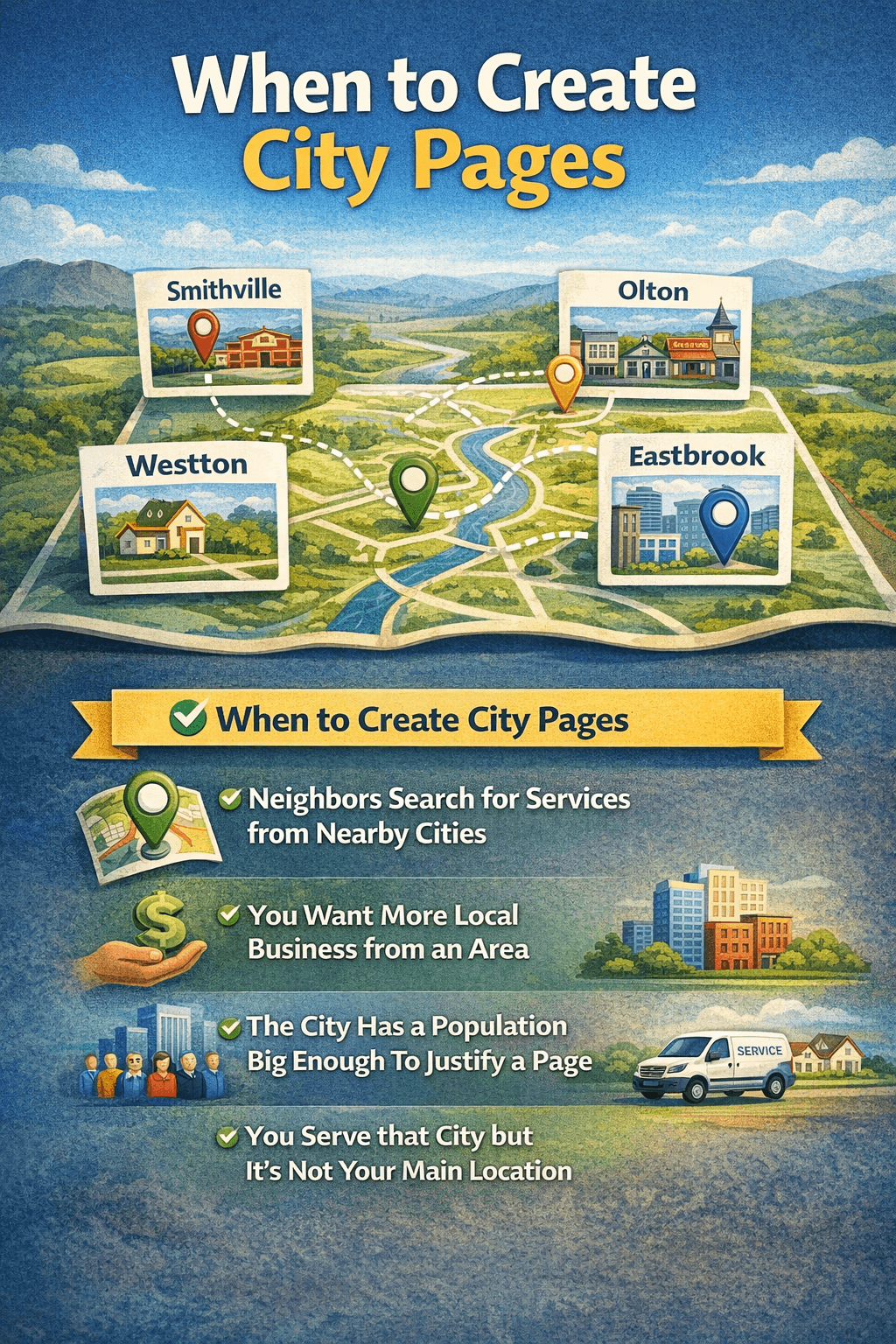
When city pages make sense
City pages are most useful when a business:
- serves more than one meaningful city or area
- wants to build visibility around specific service areas
- has enough real differentiation to support separate pages
- can connect those pages to strong core service pages
For example, a business serving Tucson, Oro Valley, Marana, and Sahuarita may have a reason to create city pages if those locations matter to the business and the service structure is already clear.
City pages work best when they sit underneath a strong service hierarchy, not when they replace it.
When city pages usually do not make sense
City pages often underperform when a business creates them:
- before building strong core service pages
- for cities it barely serves
- with mostly duplicated copy
- without clear internal links
- without enough local fit or service relevance
That usually creates thin pages that add clutter more than authority.
If the site structure is weak to begin with, city pages often make the problem worse. They create more URLs, more overlap, and more weak paths for Google and visitors.
Build service pages first
Before creating city pages, most local businesses should have strong core service pages in place.
That means the site should already explain:
- what services the business offers
- which services matter most
- how those services are organized
- what the visitor should do next
If those pages are weak, city pages usually do not solve the real problem.
For more on that structure, see Homepage vs Service Page Hierarchy and Anatomy of a High-Converting Service Page.
City pages should support the service structure
A city page should usually connect back to the core service it represents. That helps both users and search engines understand the relationship between the service and the location.
For example:
- homepage
- main plumbing service page
- water heater repair page
- water heater repair in Oro Valley page
That is much stronger than publishing random city pages with weak ties to the rest of the site.
This is where Internal Linking for Local Authority becomes important.
What a city page should include
A useful city page usually needs:
- a clear service + city match
- plain language about what the business offers in that area
- service area confirmation
- trust signals
- a visible next step
It should not read like a find-and-replace template with a city name dropped into generic copy.
Signs your city pages may be hurting more than helping
- the pages are thin
- the city name is repeated without adding clarity
- the page does not clearly connect to a service
- multiple pages feel almost identical
- the pages get indexed but produce no calls
That usually means the site has more location pages than real location strategy.
City pages and intent still have to match
A city page does not convert just because it includes a place name. It still needs to match what the visitor is looking for and make the next step feel clear.
If the page attracts weak searches or does not help someone decide, it becomes another version of traffic that does not match buying intent.
Do not let city pages replace local proof
Some businesses try to compensate for weak trust by creating more location pages. That rarely works.
More pages do not fix:
- weak reviews
- thin service explanations
- unclear fit
- poor page structure
- bad call-to-action flow
City pages work better when the underlying site already has enough structure and trust to support them.
What to do next
If you are considering city pages, start with the structure first:
- tighten core service pages
- clarify the homepage-to-service hierarchy
- make sure internal links support the service structure
- create city pages only where there is a real local strategy behind them
If you want to see how stronger structure looks once it is implemented, review Before-and-After Service Page Structure Examples.
If your site is visible but location pages are not turning into calls, the Pipeline Profit Inspection helps identify whether the issue is structure, page quality, intent mismatch, or weak handoff.
- Home
- Service Page Structure
- When to Create City Pages