When your marketing data
doesn't match reality
I investigate why.
Helping service businesses make confident marketing decisions.
How to Structure Service Pages That Turn Traffic Into Booked Jobs
Many local service businesses get traffic but struggle to turn that traffic into calls. The issue is often not visibility. It is structure.
When service pages are vague, poorly organized, or unclear about the next step, visitors hesitate. That hesitation costs booked jobs.
This guide explains how service pages should be structured so the right visitors understand what you do, trust the business, and know how to take the next step.
The job of a service page
A service page has one primary job: confirm to the searcher that they found the right business for the problem they need solved.
That confirmation happens quickly. Visitors typically decide within seconds whether to keep reading or move on to another company.
When a page is structured well, it does four things clearly:
- Matches the searcher’s intent
- Explains the service in plain language
- Builds trust with proof and clarity
- Shows an obvious next step to call or request service
When those pieces are missing, the page may still rank but fail to produce calls.
If that sounds familiar, start with Why Most Service Pages Don’t Convert.
Start with the right service hierarchy
A strong service page structure begins with the way the website organizes services.
Most local sites should follow a clear hierarchy:
- Homepage
- Main service pages
- Supporting or specialty services
- Location or city pages (when appropriate)
This hierarchy helps search engines understand what the business does and helps visitors quickly find the service they need.
A deeper explanation of this structure is covered in Homepage vs Service Page Hierarchy.
Match the searcher's intent
Not every search represents someone ready to hire.
A service page should focus on searches tied to real service needs, not broad informational queries.
When a page attracts the wrong type of search traffic, it can produce impressions and clicks but very few calls.
This problem is explored in Traffic vs Buying Intent.
Structure the page so decisions are easy
Visitors should not need to “figure out” what a business does.
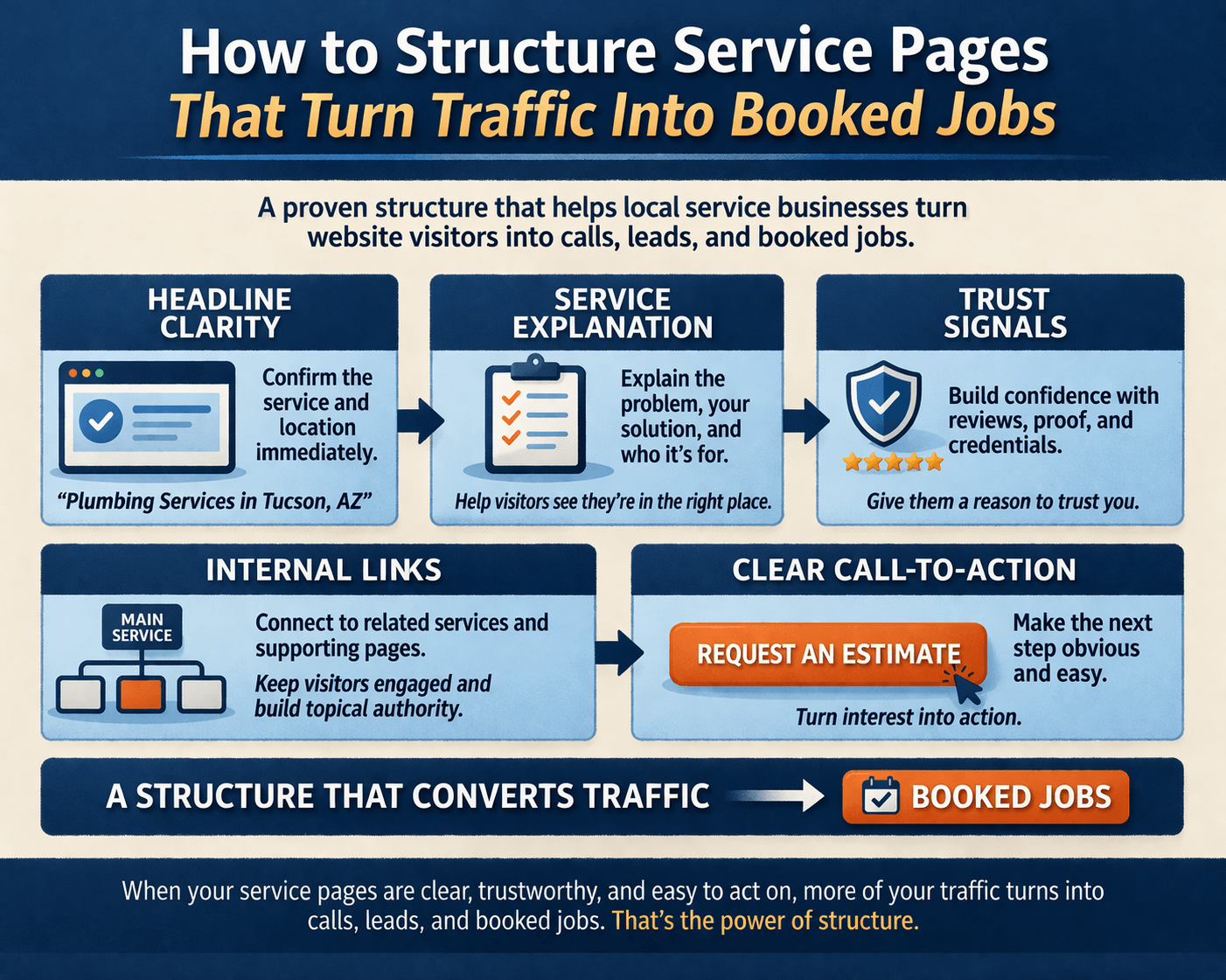
A strong service page usually includes:
- A clear headline that confirms the service
- A short explanation of the problem the service solves
- Details about the service itself
- Proof such as reviews, experience, or examples
- Clear contact or booking options
For a detailed breakdown of page sections, see Anatomy of a High-Converting Service Page.
Use internal links to strengthen authority
Service pages should not exist in isolation.
When pages link logically to related services, supporting pages, and location pages, they reinforce the authority of the whole site.
Internal linking also helps visitors navigate naturally between related services.
A deeper look at this structure is explained in How Internal Linking Builds Local Authority.
Decide when city pages make sense
Many local businesses try to create dozens of location pages without a clear strategy.
Sometimes city pages help visibility. Sometimes they dilute authority and create thin content.
Understanding when to create them is part of a good site structure.
See When to Create City Pages for a deeper explanation.
Make the next step obvious
Even strong service pages lose leads when the next step is unclear.
Visitors should immediately know how to:
- Call
- Request an estimate
- Book service
Call-to-action language should guide the visitor without sounding desperate or pushy.
For examples, see Calls-to-Action That Convert Without Desperation.
Service page structure is a competitive advantage
Many businesses focus heavily on rankings and traffic while overlooking the structure of the pages visitors land on.
When service pages are clear, organized, and designed around real customer decisions, they tend to outperform competitors even with similar visibility.
If you want to see examples of stronger page structures, review Before-and-After Service Page Structure Examples.
When traffic still does not produce calls
If your pages are getting visibility but calls remain inconsistent, the problem may be somewhere in the pipeline between search and booked job.
The Pipeline Profit Inspection reviews that path from search visibility to booked jobs and identifies where leads are leaking.
For many businesses, fixing the structure of service pages is one of the fastest ways to improve conversion from existing traffic.
- Home
- Local SEO Tucson
- Service Page Structure