When your marketing data
doesn't match reality
I investigate why.
Helping service businesses make confident marketing decisions.
Anatomy of a High-Converting Service Page
A service page should do more than describe a service. It should help the right visitor decide to contact you.
A lot of local service pages get traffic but still underperform because the structure is weak. The visitor lands, scans, hesitates, and leaves.
If that sounds familiar, start with Why Most Service Pages Don’t Convert.
This page breaks down the sections that make a service page easier to trust, easier to understand, and easier to act on.
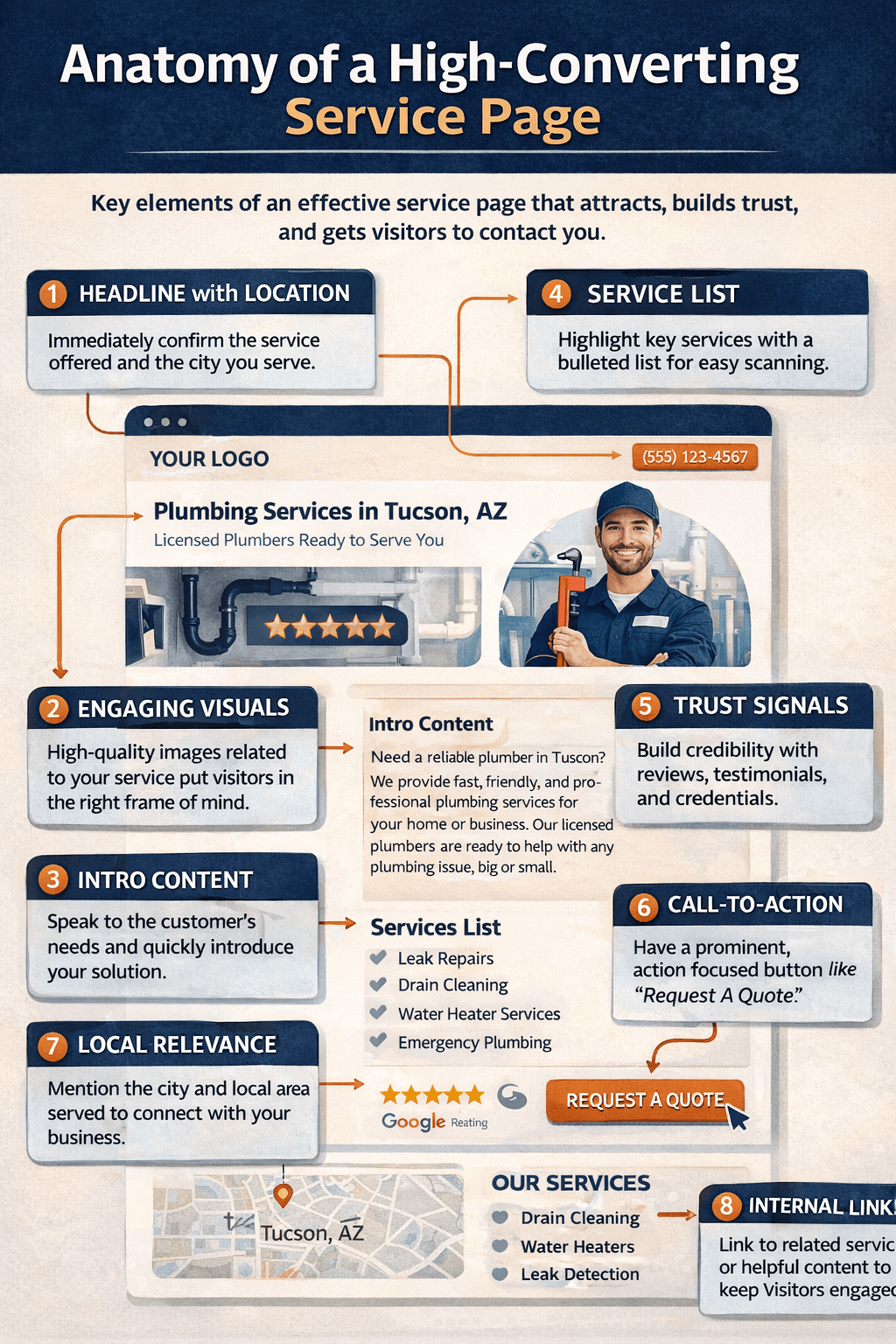
Start with the Pipeline Profit Inspection if your service pages are getting seen but not producing enough calls.
What a strong service page needs to do
A high-converting service page usually does six things well:
- confirms the visitor is in the right place
- explains the service clearly
- shows who the service is for
- builds trust fast
- reduces friction around the next step
- supports both search intent and action
If one of those pieces is weak, the page may still rank and still fail to produce booked jobs. That is part of the larger problem behind getting traffic but no calls.
For the full structural framework, see How to Structure Service Pages That Turn Traffic Into Booked Jobs.
1. A headline that confirms the service immediately
The headline should make the service obvious. It should not be clever, vague, or brand-first.
A visitor should be able to tell within seconds:
- what service you offer
- who it is for
- where you provide it, when relevant
If the headline creates uncertainty, people start backing away before the page has a chance to work.
2. A short opening section that explains the problem and the service
Right below the headline, the page should quickly explain what the service solves and why someone would contact you for it.
This is where many pages get too broad. They talk around the service instead of helping the visitor confirm a match.
A strong opening reduces confusion and lowers the chance that the page attracts traffic that does not match buying intent.
3. Clear service detail
After the opening, the page should explain what the service actually includes. Not every visitor needs deep detail, but they do need enough clarity to understand what happens next.
Good service detail can include:
- what the service is
- what problems it addresses
- what the process looks like
- what kinds of customers it is best for
If this section is too thin, the page feels generic. If it is too bloated, the page becomes hard to scan.
4. Trust signals placed where the visitor needs them
Trust should not be saved for the very bottom of the page. It should appear throughout the page where it helps reduce uncertainty.
Trust signals can include:
- reviews or testimonials
- years of experience
- photos of real work
- specific outcomes
- credentials or certifications
- clear service area information
Without enough trust, a page can attract clicks and still fail to produce calls. That is one of the most common visibility-to-call breakdowns.
5. A clear service area or fit statement
The visitor should not have to guess whether you serve their area or handle their type of job.
This matters for both conversions and structure. A page should make it clear whether it is:
- a core service page
- a city page
- a specialty service page
If you are unsure when city pages belong in the structure, see When to Create City Pages.
6. A visible and low-friction call to action
The next step should be obvious. Call, request an estimate, book an appointment, or submit a form. But the page should not make people hunt for it.
The call to action should feel direct and easy, not needy or vague.
For more on that, see Calls-to-Action That Convert Without Desperation.
7. Structure that supports scanning
Most visitors do not read service pages from top to bottom. They scan.
That means the page should be easy to move through:
- clear headings
- short paragraphs
- logical section order
- visible trust elements
- repeated but not excessive calls to action
If the page is cluttered, hard to scan, or overly dense, visitors stall.
8. Internal links that support the service structure
A strong service page should not sit alone. It should connect naturally to related service pages, supporting pages, and sometimes location pages.
That strengthens authority and helps the visitor move through the site without getting lost.
For more on that, see How Internal Linking Builds Local Authority and Homepage vs Service Page Hierarchy.
What a high-converting service page is not
It is not a wall of text. It is not stuffed with keywords. It is not a vague brand statement with a phone number dropped at the bottom.
A high-converting service page is structured to help the right person make a decision with less uncertainty.
Why this matters
Many local businesses focus on getting more traffic when the better move is improving the pages that already receive traffic.
A better page structure can lift calls and booked jobs without waiting for a major ranking increase. That is why service page structure is a real competitive advantage.
If you want to see what better page structure looks like in practice, review Before-and-After Service Page Structure Examples.
If your service pages are visible but underperforming, the Pipeline Profit Inspection helps identify where the page structure, intent match, or handoff is breaking down.
- Home
- Service Page Structure
- Anatomy of a High-Converting Page