When your marketing data
doesn't match reality
I investigate why.
Helping service businesses make confident marketing decisions.
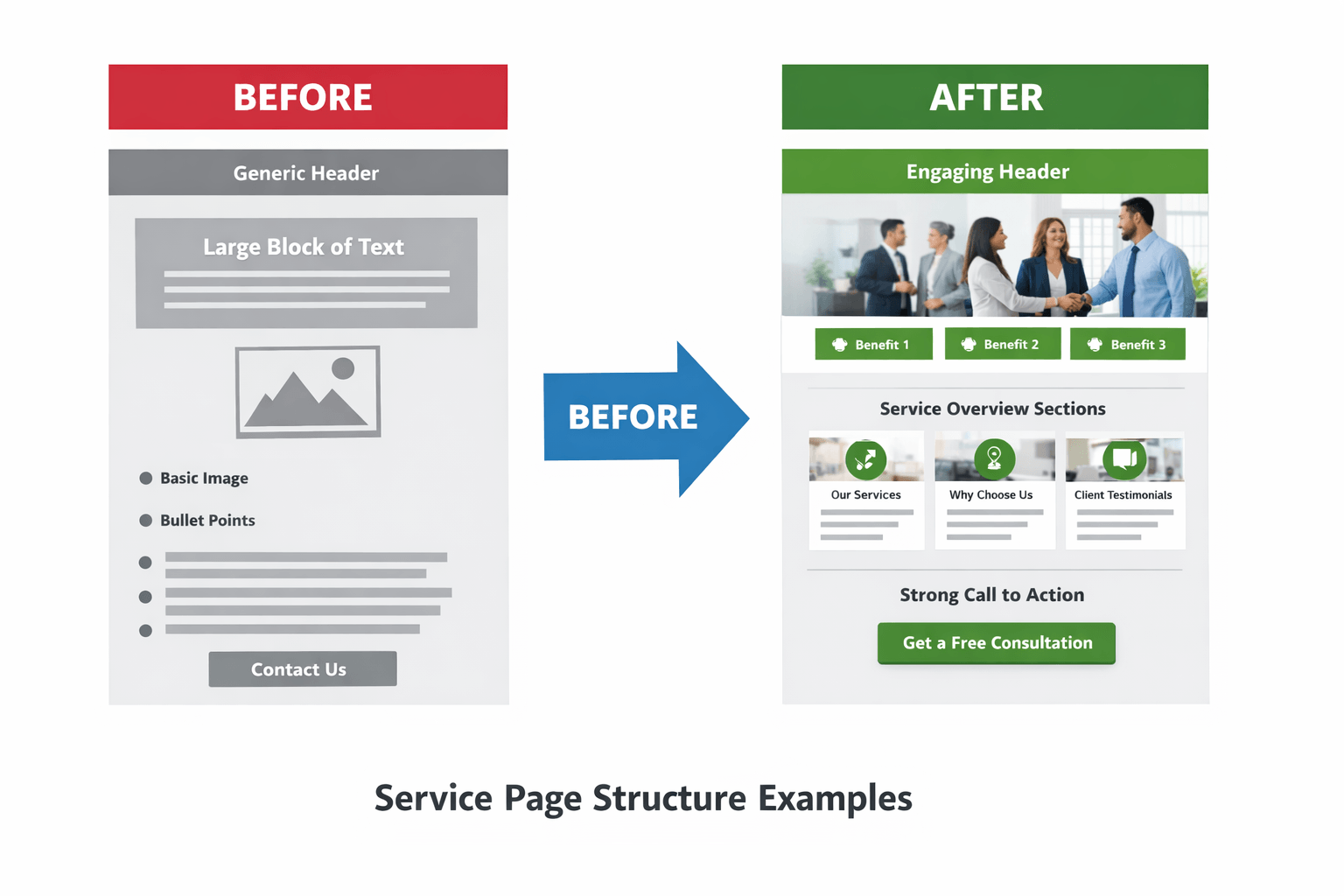
Before-and-After Service Page Structure Examples
A lot of service pages do not fail because the business is bad. They fail because the page structure does not help the visitor decide.
The good news is that this is usually fixable. A stronger structure can make the page clearer, more trustworthy, and easier to act on without needing a full rewrite of the entire website.
If your pages are getting traffic but not enough response, this is often part of the larger problem behind Why Most Service Pages Don’t Convert.
Start with the Pipeline Profit Inspection if your service pages are visible but not producing enough booked jobs.
What usually changes between a weak page and a stronger one
The difference is usually not “better writing” in the abstract. It is better structure.
A stronger service page tends to:
- confirm the service faster
- reduce uncertainty earlier
- show trust before the visitor has to ask for it
- make the next step more obvious
- fit more cleanly inside the site hierarchy
That is how a page moves from being visible to being more useful.
For the full framework behind these improvements, see How to Structure Service Pages That Turn Traffic Into Booked Jobs.
Example 1: vague service page vs clear service page
Before
The page opens with generic language like “high-quality solutions for your needs.” The headline does not clearly say what the service is. The first few sections talk broadly about the company instead of the service.
- headline is vague
- service is not confirmed fast
- visitor has to work to understand the offer
- CTA is weak or buried
After
The page opens with a direct service headline. The first section explains what the service is, who it is for, and what problem it solves. The visitor can confirm a match quickly.
- headline confirms the service immediately
- opening section reduces confusion
- page feels easier to scan
- CTA appears earlier and more clearly
This is the kind of structure covered in Anatomy of a High-Converting Service Page.
Example 2: ranking page vs decision page
Before
The page may attract search traffic, but the content is broad and loosely tied to the actual decision someone needs to make. It reads more like a topic page than a service page.
- traffic comes in
- page does not strongly match buying intent
- visitor reads a little, then leaves
After
The page is tightened around a service-level need. The wording is more specific. The examples, proof, and CTA all support the action the business wants the visitor to take.
- page matches a stronger service-level search
- content supports a real decision
- traffic is more likely to turn into calls
This connects back to the problem behind traffic that does not match buying intent.
Example 3: trust-light page vs trust-supported page
Before
The page explains the service, but gives the visitor very little reason to trust the business. There are no specific reviews, no proof, no signs of experience, and no visible reassurance.
- service may be clear
- trust is weak
- visitor keeps comparing options
After
The page includes trust signals in the places where the visitor needs them: specific proof, relevant reviews, experience, photos, service-area clarity, or examples of work.
- page feels safer
- fewer unanswered questions
- visitor has more confidence to act
That kind of improvement helps fix one of the common visibility-to-call breakdowns.
Example 4: cluttered page path vs clean page path
Before
The page has too much competing information. The sections feel out of order. The visitor is not sure where to look next or what step to take.
- too many ideas competing on one page
- important information is buried
- CTA does not stand out
After
The page follows a cleaner sequence: service confirmation, explanation, trust, fit, and next step. The visitor moves through the page more naturally.
- structure supports scanning
- important sections are easier to find
- the call to action feels more natural
This is closely tied to Calls-to-Action That Convert Without Desperation.
Example 5: isolated page vs page inside a stronger hierarchy
Before
The page exists on the site, but it is weakly connected. The homepage does not route to it well. Related pages do not support it. The visitor has few useful paths forward.
- page feels isolated
- internal links are weak
- site hierarchy does not reinforce the page
After
The page sits inside a clearer service structure. The homepage links into it. Related service and support pages connect to it naturally. The page feels like part of a real system.
- authority flows into the page more cleanly
- visitors can move through the topic more easily
- Google gets stronger structure signals
For more on that, see Homepage vs Service Page Hierarchy and How Internal Linking Builds Local Authority.
What these examples show
A better service page is usually not about adding more words. It is about making the page easier to understand, easier to trust, and easier to act on.
That is why structure matters so much. A page can have decent visibility and still underperform if the page itself is doing weak decision work.
That is also why some businesses end up getting traffic but no calls. The traffic reaches the page, but the page does not close the gap between search and action.
What to do next
If your service pages are underperforming, compare them against these questions:
- Does the headline confirm the service fast?
- Does the opening section explain the service clearly?
- Does the page build trust before asking for action?
- Is the CTA visible and easy to act on?
- Does the page sit inside a clean hierarchy?
If the answer to several of those is no, the page likely has a structure problem, not just a traffic problem.
If your pages are visible but not producing enough booked jobs, the Pipeline Profit Inspection helps identify where the structure, trust, intent match, or handoff is breaking down.
- Home
- Service Page Structure
- Before-and-After Examples